We've settled into a rhythm for our days for the preschoolers (all of them are 2 years old. There is a 2.25 boy, a 2.5 boy, and a 2.75 girl.) And while there are some Montessori materials on the shelves, we also have some Waldorf Materials too and our rhythm leans toward a more Waldorf type of rhythm too.
Our Daily Rhythm
Arrival - Free Play - Coloring - Morning Circle - Scheduled Activity (painting, play-doh, making bread, cut and glue activity, or making soup - each child brings a vegetable from home to contribute to our soup) - Morning Snack - Outdoor Play - Lunch - Nap - Free Play - Outdoor Play - Dismissal
The baby is still on her own schedule, although she does tend to play nearby during our circle time, and we include her at the table when we are over there, as well as take her outside if she is awake during those times. She is coming closer and closer to napping at the same time as the 2 year olds too.
Our circle time consists of singing songs/finger plays, and then we talk about the letter of the week, sing our calendar song, and our weather song. Then each child has a "helper" job for the week - one child does our color of the month (this month is red), one child does our number of the month (this month is one) and the third child does our shape of the month (this month is circle). We sing a song for each of the helper jobs, and the helper does a little activity (like find something red, sing a song with the sandpaper shape, do that number of chants/claps/fingers, etc.) After helper jobs, I read a story.
During free play, the children can pick items off the shelves. If the child picks a Montessori material, the first time, I will give the child an individual lesson. It sounds very formal when I write it like that, but it is actually occurring quite naturally, in fact, more naturally this year than in other years.
The children are naturally incorporated in practical life activities instead of having lots of practical life activities to choose from on the shelves, although I do have a couple practical life items out on the shelves. The children help with such things as sweeping, wiping the tables, straightening up, and undressing and dressing themselves. The children also help with the garden during the summer/early fall and late spring.
We do have a dog, and the children help by telling the dog to go outside and to go back to "his" room to lay down as well as giving him water in the afternoon. We are hoping to get a fish soon too.
Showing posts with label montessori. Show all posts
Showing posts with label montessori. Show all posts
Tuesday, September 14, 2010


Thursday, April 22, 2010
Knobless Cylinders . . .
 (picture from the Nienhaus website)
I was on the fence for the longest time about buying these - and I even tried selling them once because they didn't get used much back then. But this year - WOW. In the last month, the knobless cylinders have been out so often in the Preschool Area. And they have learned so much from using them.
In fact, this year has been an interesting year for me, Montessori-wise. This is the only year in the past 7 years that I have had more than one child that is doing lots of work in Period 5 (and in Period 4 too) I'm also often seeing one or two children using the knobless cylinders, another using the brown stairs, and another using the block tower, and then they talk about how they each have ten, and how they can all stack up, etc. The Montessori materials never cease to amaze me - I don't even have to open my mouth and they learn the concepts, just from using the materials.
In fact, this year has been an interesting year for me, Montessori-wise. This is the only year in the past 7 years that I have had more than one child that is doing lots of work in Period 5 (and in Period 4 too) I'm also often seeing one or two children using the knobless cylinders, another using the brown stairs, and another using the block tower, and then they talk about how they each have ten, and how they can all stack up, etc. The Montessori materials never cease to amaze me - I don't even have to open my mouth and they learn the concepts, just from using the materials.
Saturday, February 6, 2010
It seems that everyone in the Montessori blog world is talking alphabet . . .
I recently made a change to how I had been doing the letters. I had originally been using the ideas/order that is presented at My Montessori Journey. The problem was that I was ALSO introducing a letter of the week (starting with "a" at the beginning of the year), and it was generally different than the ones we were working on with the Red/Yellow/Blue scheme. It was just getting too confusing.
So I've made a decision - we are going to drop the Red/Yellow/Blue scheme. I understand that presenting the letters to the children in the order that they are in the alphabet probably really isn't the best way to introduce them. But it is the way that is working best for these children this year.
I am, however, using similar resources found at My Montessori Journey (particularly from KidSoup) combined with ideas that were contained in the language album from the Montessori Online Training Course that I am taking - particularly the idea of Sound Boxes, although I keep all the items for the Sound Boxes on my newly named Letter Shelf. (What DID we do all day is taking the course too, so that is why some of our resources look similar.)
Here is my new Letter Shelf:
 The top of the Letter Shelf -
number of the month, shape of the month
 Picture of the whole Letter Shelf
 Cards that go with our Alphabet Song.
(on the first shelf) See next photo for more explanation.
 We sing our Alphabet Song (not the traditional one. The tune is "Twinkle Twinkle" and it starts with the letter sound, then letter name, and then the object presented. So for A, it is a (as in in appple), A (as in ate), Apple, buh, B, ball. kuh, C, cat, duh, D, dog. )
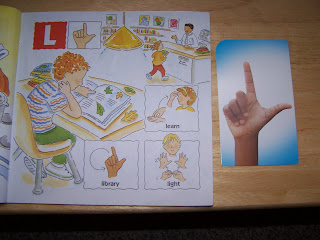 We learn the sign language sign for that letter and a sign language word that starts with that letter.
 We do the letter of the week with the Leap Frog Fridge Magnets and sing along.
 We review our letter of the week poster and letter of the week words from KidsSoup.
 Find the Letter learning page from KidsSoup
 Write/Trace the letter from KidsSoup
 Trace words that start with that letter from KidSoup
 There is also a sandpaper letter by the sand tray at the Sensory Table for the letter of the week and there is a cookie cutter out at the play-doh table for letter of the week. I got the letter and number cookie cutters from Michael's. It came in a big container with all the letters and numbers. LOVE IT.

Alphabet flashcards that show the capital and lowercase letters together (on the 2nd shelf. The Flashcards came from the dollar section at Target last fall.)
 "Objects" from Learning Resources Alphabet Center
 Outside of Little Letter Books - Little Letter books from KidsSoup
So I've made a decision - we are going to drop the Red/Yellow/Blue scheme. I understand that presenting the letters to the children in the order that they are in the alphabet probably really isn't the best way to introduce them. But it is the way that is working best for these children this year.
I am, however, using similar resources found at My Montessori Journey (particularly from KidSoup) combined with ideas that were contained in the language album from the Montessori Online Training Course that I am taking - particularly the idea of Sound Boxes, although I keep all the items for the Sound Boxes on my newly named Letter Shelf. (What DID we do all day is taking the course too, so that is why some of our resources look similar.)
Here is my new Letter Shelf:
 The top of the Letter Shelf -
number of the month, shape of the month
and letter of the week.
 Picture of the whole Letter Shelf
 Cards that go with our Alphabet Song.
(on the first shelf) See next photo for more explanation.
 We sing our Alphabet Song (not the traditional one. The tune is "Twinkle Twinkle" and it starts with the letter sound, then letter name, and then the object presented. So for A, it is a (as in in appple), A (as in ate), Apple, buh, B, ball. kuh, C, cat, duh, D, dog. )
For the current letter of the week:
 We learn the sign language sign for that letter and a sign language word that starts with that letter.
 We do the letter of the week with the Leap Frog Fridge Magnets and sing along.
 We review our letter of the week poster and letter of the week words from KidsSoup.
These sheets are on the Writing Shelf for the letter of the week.
 Find the Letter learning page from KidsSoup
 Write/Trace the letter from KidsSoup
 Trace words that start with that letter from KidSoup
There is also a letter coloring sheet on the Art Shelf for the letter of the week.

 There is also a sandpaper letter by the sand tray at the Sensory Table for the letter of the week and there is a cookie cutter out at the play-doh table for letter of the week. I got the letter and number cookie cutters from Michael's. It came in a big container with all the letters and numbers. LOVE IT.
For the rest of these activities, I have two letters out - the letter for current week, and the letter for the previous week. These are held in the Letter Shelf.

Alphabet flashcards that show the capital and lowercase letters together (on the 2nd shelf. The Flashcards came from the dollar section at Target last fall.)
 "Objects" from Learning Resources Alphabet Center
(On the 2nd shelf - these objects are in a plastic card file box)
 Letter Cards from KidsSoup
 Inside of Little Letter Book
 Letter Cards from KidsSoup
(bottom shelf - in right blue container)
 Inside of Little Letter Book
 Outside of Little Letter Books - Little Letter books from KidsSoup
(on bottom shelf - left blue container)
The pictures in the Letter Cards are the same pictures that appear in the Little Letter Books.
==============================
So far, LOVING the new system. The children are really learning the letter sounds and they enjoy doing many of the activities.
Wednesday, February 3, 2010
I Heart Montessori For Everyone!
I remember seeing Lori's materials back on e-bay a number of years ago. I've been teaching preschool using the Montessori Method since Flower was 3 (she is 10 now.) Back then, there was VERY little available on web. There were these on-line manuals, but that was about it. Two or three years later, a few people started selling montessori materials on e-bay. Around that time, I remember seeing Lori's printed materials on e-bay. I think I might have bought a couple of 3 part cards sets back then.
And then I just sort of carried on, learning things from books, and the on-line manuals, and David Gettman's book, and Lillard's Montessori In The Classroom book, and just doing it. A couple years ago, I started a blog for my family, and suddenly I noticed that there were many other people out there who had blogs and used Montessori, and then I stumbed on Lori's blog and her company - Montessori For Everyone (she sells things through her own online store now instead of selling them on e-bay.) I ordered a few things from her - mostly pre-reading activities for the preschoolers. I was starting to think about homeschooling my daughter (who was in 2nd grade at the time) and I e-mailed her to ask her about homeschooling an elementary aged child with Montessori. She graciously e-mailed back and answered all of my questions.
I did start homeschooling the next year, and I ordered a few more things for Flower and a few more for the preschoolers (mostly science related).
But this year, I don't know what I would do without her materials, especially for the homeschoolers. She has truly been a lifesaver! I didn't start the school year with a plan to order much from her - maybe some art cards or maybe some math sets. In November, we decided to teach grammar to all the kids using Montessori grammar and so I ordered most of the Word Study cards. It has made a HUGE difference in their excitement about the subject and their retention. And then I ordered the Continent Kits and US Kit. The homeschoolers LOVE them. I did get some art sets, music sets, and math sets too. And then the Botany Nomenclature Card Set. For the preschoolers, I ordered the farm cards. It has been so a blessing to have reasonably priced materials that are so well done. And Lori has again this year been so wonderful answering any questions that I might have about the materials or homeschooling.
Thank you Lori at Montessori For Everyone!
Wednesday, November 18, 2009
Small Hands
You may notice a new little button in the top right corner that says "Help Us Earn Free Materials! Browse For Small Hands Now."
For Small Hands is a catalog put out by Montessori Services. This catalog contains many hands-on materials that will help young children engage in real life experiences such as pouring, gardening, and painting.
If you place an order for $25 or more, then Montgomery Academy will receive a 10% credit of the total bill to put towards Montessori Materials for our classroom. Please use our classroom number 100641 so that Montgomery Academy will receive the credit. The promotion ends on December 31st, 2009, however, you will want to order your items by November 22nd if you want to ensure that your items will arrive before Christmas.
(Parents of Montgomery Academy students, we will be placing a group order. Please do not place an individual order. Instead, please turn in your order form to me by November 23rd and I will place the group order on-line that evening so that the items will be here before Christmas. However, feel free to tell your friends and relatives to place an individual order. )
Tuesday, July 14, 2009
Part 2: Making Montessori Materials
Printed Materials
I've printed off materials as much as I could for free. The Montessori Materials Group and the Montessori Makers Yahoo Group and their subgroups have many items for printing, as well as the Montessori By Hand Yahoo Group, and freebies at Montessori For Everyone. I have seen free downloads off from various Montessori websites and blogs. I am also currently taking an on-line Montessori Training class and have been printing manuals available to members of the course.
I also am a member of Scholastic Printables, KidsSoup, and Enchanted Learning.
Practical Life
I've picked up a lot of things at discount stores and thrift stores and things that I have at home, and put them together to make a practical life activity. Materials like:
- Little pitchers
- Little glasses/votives/dishes
- Duster/dust pan
- Eyedroppers
- Dish Drainer/Drain Mat/Dishpan/Dishcloths/Sponge
- Cloth Napkins
- Containers with different closures
- Vases
- Mirrors
- Cloths
- Aprons
- Spoons/Scoops/Tongs
- Baskets
- Trays
I'm always on the lookout for items that I could use in preschool, but perhaps not in the way that people traditionally use it.
Sensorial
- I made the color tablets twice actually. Once I wrapped embroidery floss around embroidery spools. The children would eventually start messing with the floss and it would come off. Then I made it out of paint chips. It was a little time consuming, plus I found that I needed to laminate it so that it wouldn't get bent, and then they didn't use it much. However, when I purchased Color Box 1 and 2, there was a renewed interest in it, and it still gets used fairly often. I am in the process of making Color Box 3 out of paint chips actually, just because I think that since it is more of putting the shades in order, that it will be o.k. if they aren't as thick, etc. as the real tablets.
- I made the sound boxes. I collected 6 bubble containers in one color and 6 bubble containers in another color. I put a variety of items inside it and glued the lids on.
- I made the rough and smooth boards and the graded tablets. I got the sandpaper at a hardware store, and the wood and glue at Hobby Lobby. I'm glad that I made this, because it doesn't get a lot of use.
- I made the fabric matching with some fabric scraps that I had around. The children use this on a somewhat regular basis. I switch the fabric every so often.
- I made the thermic bottles. I got some very small metal containers (shaped like metal milk containers) and some small corks at Hobby Lobby. This isn't out on a regular basis, but the children enjoy it during the time that it is out. There is a dot of paint on the bottom in a 3 different colors for the control.
- I made the smelling bottles. I used 8 dark matching salt/pepper shakers. Again, this isn't out on a regular basis, but they do enjoy it. There is a drop of paint on the bottom in 4 different colors for the control.
- I made tasting bottles out of dark bottles and eyedroppers. I put a drop of paint (two with red, two yellow, two blue, and two green) on the bottom for the control. I think I ordered the bottles and droppers from Montessori Services.
- I made the constructive triangles out of very stiff felt that I got at Hobby Lobby. I store them in wood rectangle boxes with lids that I got at Hobby Lobby that have a painted number on top to distinguish one from another.
- I made the Red Rods, although mine were natural colored, and they weren't the exact dimensions of the Montessori Red Rods. They worked o.k., but weren't used as much as the block tower or broad stair. I eventually bought it from Alison's and the Red Holder. The paint has chipped a lot, and Super occasionally uses them as swords. I probably should have just kept the ones I made, or not had them at all.
- I made baric tablets out of small boxes with lids that were weighted down with varying weights (taped to the inside bottom of the box.) Then the entire box was taped shut.
- I made sandpaper shapes using matboard and sandpaper.
- I decided not to make the geometric cabinet. I had considered saving up for it and purchasing it, but I have decided that the insets and shape puzzles will be enough for us.
- I printed out the red/yellow/blue downloads from My Montessori Journey, and created similar sound books, etc. based on her description of the system.
- I made the Spindle Box with a cookie sheet and then long utensil holders taped together and address stick-on numbers at the top of the holders. I used craft sticks for the spindles. It worked o.k., but not great. I'm planning on buying it.
- For cards and counters, I bought some magnetic numbers from a teacher supply store, and used red poker chips for the counters. I also use create many seasonal cards and counters activities from items that I purchase at Hobby Lobby. (I got this idea from My Montessori Journey.)
- I also create lots of seasonal matching and sorting activities with items that I get at Hobby Lobby or Dollar Store.
Science/Geography
- I printed and laminated Animal/Plant/Body Classification cards, landform cards, and animals by continent.
- I also put out books and Dover books from our book collection that match the zoology and botany puzzle that we are working on for each month.
- I made landforms out of Sculpey clay and disposable containers.
- I am working on making landform cards out of matboard and sandpaper.
Art/Sensory
- I always make my own homemade playdoh, and I use beans, pom-poms, shaving cream, sand, etc. that I have on hand.
Sunday, July 12, 2009
Part 1: Buying Montessori Materials
I think most parents who decide to use Montessori At Home go through something like this:
1. Find out about Montessori, and decide that it is great.
2. Try and figure out whether to send child to a Montessori school or teach them at home, and decide to teach them at home.
3. Look at all the Montessori materials and the prices. Realize that it probably isn't reasonable to be able to buy EVERY SINGLE Montessori material.
4. Decide to make all of them.
5. Decide that perhaps it might be best to purchase the ones that would be extremely difficult/not cost effective to make, and make others.
This is certainly the path that I decided to take. Back in 2003, I decided to teach my then 3 year old Flower (she is 9 now!) and two of my girlfriends' children using Montessori. I had recently been laid off, and didn't have much of a budget to buy things (some things never change! LOL) But I hoped that I would continue to use the materials for future children and future students, and that is the way that it has turned out.
FYI, Over the years, I have generally had children that were between the ages of 2.5 and young 5s. Most of the children did not use many of the bead materials or the language materials, and I've only had two children over the years that was reading for any significant portion of time. I've never had a child who went beyond the pink series in the Language area before moving on to Kindergarten. The children generally found most of the Geography Puzzles were too difficult, and only regularly The Continent World puzzle and the North America puzzle.
Here are the materials that I decided to buy. Most of the things I purchased, and unless otherwise noted, were from Montessori N' Such. Over the years, I've also bought a few things from Montessori Services, and Alison's Montessori, and Montessori For Everyone, e-bay and Neinhaus.
Practical Life
I bought the Continent Kit from Montessori For Everyone.
In Part 2, I will discuss the Montessori Materials that I have made/in the process of making/planning on making.
1. Find out about Montessori, and decide that it is great.
2. Try and figure out whether to send child to a Montessori school or teach them at home, and decide to teach them at home.
3. Look at all the Montessori materials and the prices. Realize that it probably isn't reasonable to be able to buy EVERY SINGLE Montessori material.
4. Decide to make all of them.
5. Decide that perhaps it might be best to purchase the ones that would be extremely difficult/not cost effective to make, and make others.
This is certainly the path that I decided to take. Back in 2003, I decided to teach my then 3 year old Flower (she is 9 now!) and two of my girlfriends' children using Montessori. I had recently been laid off, and didn't have much of a budget to buy things (some things never change! LOL) But I hoped that I would continue to use the materials for future children and future students, and that is the way that it has turned out.
FYI, Over the years, I have generally had children that were between the ages of 2.5 and young 5s. Most of the children did not use many of the bead materials or the language materials, and I've only had two children over the years that was reading for any significant portion of time. I've never had a child who went beyond the pink series in the Language area before moving on to Kindergarten. The children generally found most of the Geography Puzzles were too difficult, and only regularly The Continent World puzzle and the North America puzzle.
Here are the materials that I decided to buy. Most of the things I purchased, and unless otherwise noted, were from Montessori N' Such. Over the years, I've also bought a few things from Montessori Services, and Alison's Montessori, and Montessori For Everyone, e-bay and Neinhaus.
Practical Life
- 4 Dressing Frames (Buttoning, Snapping, Lacing, and Buckling). They got used very little, and I eventually sold them on Montessori Swap. This is where I sell all of my things that are not getting used. One of the preschool moms made me dressing vests, and these get used all the times.
- I bought a few trays.
- Some not necessarily traditional Montessori materials, but things that we have used in practical life area: Sew N' Sew, Melissa and Doug Shoe Lacing, Lauri Lacing Cards, Melissa and Doug Food Cutting, and a Melissa and Doug Tool Kit. I get many of the Melissa and Doug things at our local TJ Maxx or Toys R Us.
Sensorial
- I got the Natural Ten Tower because at the time, it was cheaper than the Pink Tower.
- Broad Stair
- Knobbed Cylinders
- I eventually got the Knobless Cylinders from Alison's, but probably could have been o.k. without purchasing these, but the older children like to use the knobless, and the younger use the knobbed.
- I decided not to get the Color Tablets. I made them by putting embroidery floss on embroidery spools. It worked o.k. but not great. I did purchase Box 1 and 2 a couple of years ago from Alison's.
- I bought the Color Matching Cards from Montessori For Everyone.
- I bought a Geometric Solids kit from a garage sale, and it worked o.k., but didn't have an ellipsoid or ovoid, and several shapes that the Montessori set didn't. I bought the Natural Geometric Set a couple of years ago from Montessori N' Such.
- I bought a Sterognostic Mystery Bag from Alison's.
- I bought the Binomial Cube. It rarely got used, and I sold it on Montessori Swap.
- I bought Geometric Shapes Matching cards and Geometric Solids Matching cards a couple years ago from Montessori For Everyone.
- Some not traditional Montessori but things that we have used: Tuzzles Shape Puzzles (Circle, Square, Triangles, Rectangles) from Alison's (no longer on their site), Geoboard, Melissa and Doug Pattern Blocks.
- I bought lower case sandpaper letters from someone who was making them and then selling them on e-bay. They are smaller than the traditional letters, and my consonants are blue and vowels are pink. I have not replaced them yet, but am considering it.
- I initially bought some letter tiles at teacher supply store and stored them in a tackle box, but it didn't work well. So then I bought the small plastic letters for the moveable alphabet and a wooden box.
- Montessori Plastic Insets. I purchased the plastic insets because I didn't feel that I could create them realistically myself, but I didn't have the money to purchase the metal ones.
- I purchased the Inset Tray and Inset Paper from Montessori Services.
- Purchased seasonal matching cards from Montessori For Everyone.
- Some non-tradtional Montessori items that I have used: Melissa and Doug Magnetic Letters, D & K Language Cards (In The House, Transportation, On the Farm, In the Garden, Phonics, etc. Unfortunately, no longer available. I LOVE these cards. They have a picture on the front and the word on the back. I got two sets of each so that I could also do matching activities.) I also have an Alphabet Center pocket chart (The consonants are blue and vowels are red, which is part of why I haven't purchased different sandpaper letters), and a 6 strip pocket chart to put strips in for our nursery rhyme.
- Tabletop Number Rods
- Introduction to Decimal Quantity. Purchased through Neinhaus. I purchased the plastic, fused version. I sold these a few years ago, but replaced them with wood Base 10 blocks.
- Introduction to Decimal System. Purchased through Neinhaus. I purchased the plastic, fused version. I sold these a few years ago, but replaced them with wood Base 10 blocks.
- Teen Beads and Box. Sold these, but am going to replace them this year with Math-U-See blocks, or at least use the Math-U-See color scheme.
- Ten Beads and Box. Sold these, but am going to replace them this year with Math-U-See blocks, or at least use the Math-U-See color scheme.
- 100 Bead Chain - Purchased from Montessori Swap.
- Colored Bead Stair - Purchased from Montessori Swap. Sold them, but now use Math-U-See blocks.
- Some non-traditional Montessori items, but things that we have used: Counting Bears, Melissa and Doug Magnetic Numbers, Lauri Peg Set and Melissa and Doug Bead Sequencing Set.
- Leaf Puzzle
- Flower Puzzle
- Tree Puzzle
- Bird Puzzle
- Horse Puzzle
- Fish Puzzle
- Frog Puzzle
- Turtle Puzzle
I also bought the Parts of the ____ cards for the Botany and Zoology Puzzles that I have from Montessori For Everyone.
Geography- Land and Water Globe. Purchased from Appleseed Montessori.
- Continent Globe. Purchased from Appleseed Montessori.
- Continent Map Puzzle
- North America Map Puzzle
- South America Map Puzzle
- Europe Map Puzzle
- Asia Map Puzzle
- Africa Map Puzzle
- Australia Map Puzzle
- U.S. Map Puzzle
I bought the Continent Kit from Montessori For Everyone.
In Part 2, I will discuss the Montessori Materials that I have made/in the process of making/planning on making.
Tuesday, April 28, 2009
Tuesday: Montessori - Language
I am slowly but surely adding to my language area, but one of the first things that I bought when I decided to use a Montessori-based curriculum was the sandpaper letters. We use them every day. We use them during circle time to talk about our letter of the month, but then they are used to draw letters in the sand, or to create a letter out of clay, or to match up with other versions of letters we have in the classroom. Sometimes a child will use the sandpaper letters instead of the moveable alphabet to create words.
The younger children are especially drawn to the sensorial aspect of the sandpaper letters. Often, the youngest children in the classroom will just sit on the floor and rub their fingers over the letters.
I bought my version of the sandpaper letters years ago from someone who handmade them. It is a nice set, but since they made of sandpaper glued onto matboard, they are beginning to show signs of wear and use. They are also on the smaller side. I would like to add another set next year, and this time, I plan on ordering them. But for those of you who want a set for one child, or light use, there is a small, reasonably priced set available through Lakeshore Learning.
Tuesday, April 21, 2009
Tuesday: Montessori - Sensorial Activities
Taken from "Sensorial Impressions vs. Sensorial Education" by Phoebe Child
"Thought is his human birthright, all education aims at helping the individual to think clearly about them instead of half-knowing things all in a muddle."
Sensorial education helps develop a child's intellect. Whether you believe intelligence is genetic or produced by environment, you can further it by education. Intelligence is built upon experiences and thought processes. The Montessori materials for ages 18 months to 6 are designed to help a child's mind develop the necessary skills for later intellectual learning.
Sensorial impressions of child's environment are not the same as sensorial education. Impressions are feelings, not an intellectual building block. The mind needs information to discriminate and appreciate culture, art, music, poetry, reading and all aspects of the environment. Early sensorial educational materials were provided by Dr. Montessori for this purpose.
Sensorial apparatus provides a particular purpose and focus. It includes using the child's hands, senses, and spontaneous activity. When a young child sees something new and exciting, he or she will want to touch the object. Young children will grab a new kitten and hold it immediately, they want to feel the reality of the object.
This education is not an exercise to sharpen the senses, but to allow a child to use his or her senses to understand what he or she sees. The first lessons present contrasted sensory materials, and then graded materials. This teaches concepts of comparing and contrasting. For example, the first colors introduced are the primary colors, which are the most distinct on the color chart. Red, blue, and yellow are introduced, then shades and combinations are later introduced to grade by shades. "This is the beginning of the development of the intellect and it is brought about by the intelligence working in a concentrated way on the impressions given by the senses."
Education is used to tap the young child's mind of absorbed information from the first 3 years of life. The information at this point is a sea of impressions in the unconscious mind. As a child works further the young mind becomes aware of concepts of size, color, weight, quantity and so on. This is the beginning of sensorial education. When the differences are clear, the names are introduced to describe these concepts. Montessori builds on concept upon concept. Nothing is left to chance learning. There is an order and sequence to the materials presented. Montessori's sensorial approach helps a child categorize and use his vast amount of subconscious knowledge in his or her surroundings. It is a key that unlocks the door of the mind.
Montessori understood that this intellectual activity was a manual, active approach. It came from observing her own students and is contrary to adult methods of teaching and learning. The materials are three dimensional and real. Montessori at this stage did not use pictures for teaching sensorial concepts, she believed that children wanted to see and feel the real objects.
Concentration is a by product of a child learning with his or her hands. During the ages 3 to 6 the "hands are the busiest of all." The equipment provides an intellectual education that will help a child eventually acquire his or her culture.
How are sensorial exercises provided?
Usually, the pink tower is introduced at age 3. After the child has successfully done the tower, he or she has learned several things: difference in sizes and weight, how to hold his or her fingers with the small cubes, how to grasp the largest cube, controlling arms and fingers so that tower doesn't fall, and has the good feeling of completing the task. Muscular skill, intellectual and character development combine as a whole for the child when using Montessori sensorial education.
More activities, such as the broad stair, the long stair are introduced after the pink tower. "A much more complicated exercise is that of the cylinders." The the geometric shapes are introduced. All of these activities are with 3 dimensional objects that help with eye-hand coordination and provides a concept of size and shapes for later learning.
All the other activities include use of the senses. Everything is moveable and a real object. Visual aids are not used in the sensorial education. "They cannot see properly without their hands." (Child) The marriage of the hand and mind is the cornerstone of sensorial education. With it, the child unlocks his or her world in a concrete way.
=============
When I first started teaching using the Montessori Method, I wondered whether I should spend the money to get "real" Sensorial materials, or if I should just try and use substitutes/go without/recreate them myself. What I ended up doing is recreating where I could, but there were certain materials that I decided were important, and I decided that I would buy those materials. I bought my materials through Montessori N' Such & Alison's Montessori. I bought the Pink Tower (but in Natural) Brown Stair, Red Rods, Knobbed Cylinders, and Knobless Cylinders. I purchased most of them five years ago, and I've never regretted buying them. The Sensorial Materials are generally used every day. I would like to purchase the Geometric Cabinet sometime, but it has been cost prohibitive so far.
Thursday, October 23, 2008
I use mostly a montessori-curriculum but
there are many things that I love about other methods - I love the nature study from Charlotte Mason, the history studies from Classical, the natural, wood, and rhythm of Waldorf, and the art and projects from Reggio Emilia. I recently devoted a whole bookshelf to art supplies in the classroom, and the children are free to pick from it during work time. We also have an easel for painting, and a chalkboard.
One of the ideas in the Reggio Emilia philosophy is that children have one hundred languages, most of them that are not written and spoken in the traditional way, but in more of an artistic way, that they use to express themselves and to learn things. Here is part of a poem by Loris Malaguzzi, one of the main proponents of the Reggio Emilia philosophy in the 20th century.
The child is made of one hundred.
The child has
a hundred languages
a hundred hands
a hundred thoughts
a hundred ways of thinking
of playing, of speaking.
A hundred
always a hundred
ways of listening
of marveling
of loving
a hundred joys
or singing and understanding
a hundred worlds
to discover
a hundred worlds
to invent
a hundred worlds
to dream.
— Loris Malaguzzi
The Hundred Languages of Children Exhibit
I know that sometimes it may seem like the children are bringing home endless amounts of art. But it isn't just bits of paper and glue. It is also a record of how they are learning and acquiring knowledge.
-Mrs. F
Wednesday, September 3, 2008
The 2nd First Day
It went well - not quite as good as the 1st first day, but I think part of that is because two of our friends and Super actually come every day, so it was their second day. Many were wiggly by the end of line time, but most of them were able to find work to keep them occupied during our entire work time without suggestions from me.
I'm debating about whether I have the right mix of materials out. I seem to have a lot of puzzles out - the continent map puzzle, the botany puzzles, the demonstration tray of the geometric puzzle, a number puzzle, and five "regular" puzzles.
I don't have much in my Math area - sandpaper numbers, the bead stair (my version of it anyway. I had the real version, but got rid of it a few years ago because I rarely have attend that are over 4. This one uses connecting cubes, and the colors aren't the Montessori colors.), one set of magnetic numerals on a cookie sheet (all red).
The Geography shelf has only the continent and land/water globe and the continent map puzzle. The Science area has the botany puzzles and labeled and unlabeled control cards for the puzzles and Dover sticker books for flowers, trees, and leaves.
The Language area has some memory/matching cards about summer, sandpaper letters, one set of magnetic letters on a cookie sheet, the red material that is talked about on this blog, and some DK cards that I use for vocabulary building and also later when we start using the moveable alphabet. The language area also has the metal (well, my version is plastic) insets.
The Sensorial shelf just has the block tower, the brown stair, knobbed cylinder A, and color box 1 and 2, the demonstration tray for the geometric cabinet, and geometric solids.
The Practical Life shelf has cloths/clothespins/closeline activity, cutting wood food, dressing vests (actually wearable and in their size) for zipping, buttoning and snapping, and opening/closing containers.
Art has a cutting activity as well as crayons and paint. I turn on the CD for music. There are also some building blocks, large dominoes, and shells. (I know, I'll get some pictures soon.)
I have many of the other Montessori materials and plans for some seasonal works to add to the other areas and I plan on introducing them gradually, as well as doing quite a big of rotating in the Practical Life area. I've done Grace and Courtesy lessons so far.
Things have gone well, better than I expected. So why do I still feel nervous? Why do I still feel like this is my 2nd year instead of my 6th? I need to keep reminding myself to trust and observe the children. If I do that, everything else will fall into place.
- Mrs. F
Friday, August 29, 2008
Welcome!
This is my blog about our adventures in homeschooling and my teaching 5 children in a home-based Montessori preschool. I will celebrate my sixth year as a preschool teacher in January 2009.
This year I'll be my homeschooling my 8 year old daughter, hereafter referred to as Flower. We do a mix of Charlotte Mason, Montessori, and Waldorf.
Her 6 year old sister, hereafter referred to as Jelly Bean, will be attending the local elementary school this year but will do some at home learning occassionally and join us on some of our field trips.
Her 3 year old brother, hereafter referred to as Super, will be attending preschool with 5 of his friends. We have three friends who are returning and two new friends.
I'll be blogging about all things learning here, so that will be things like our classroom, various activities that we do, our schedules and routines, etc.
Subscribe to:
Posts (Atom)